
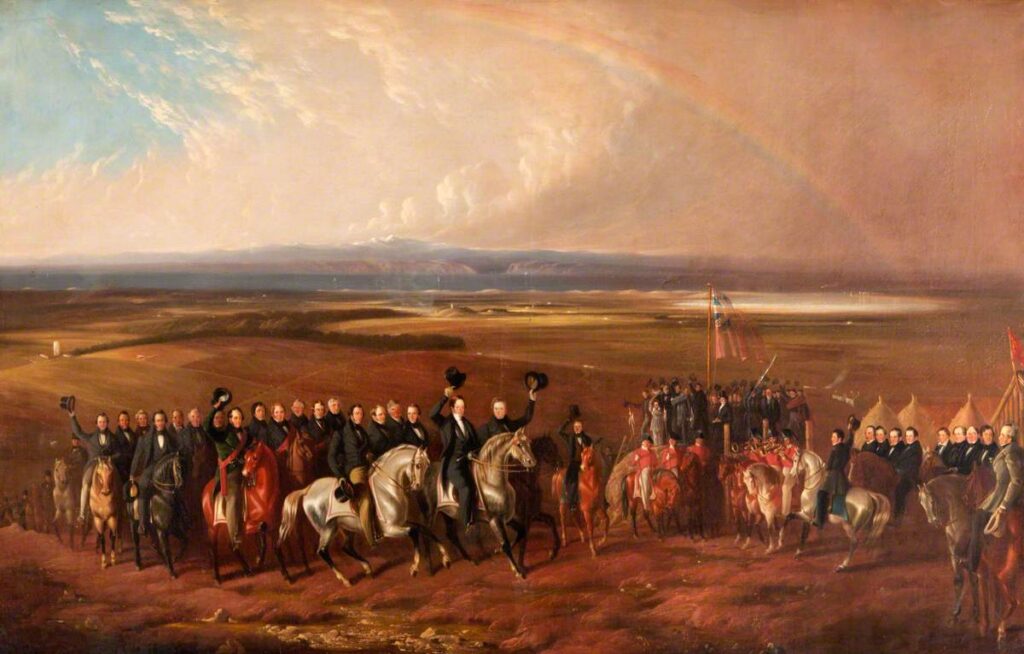
The unveiling of the painting was recorded at the time by an article in the Forres Gazette in June 1841
Magnificent Painting of the Riding of the Marches
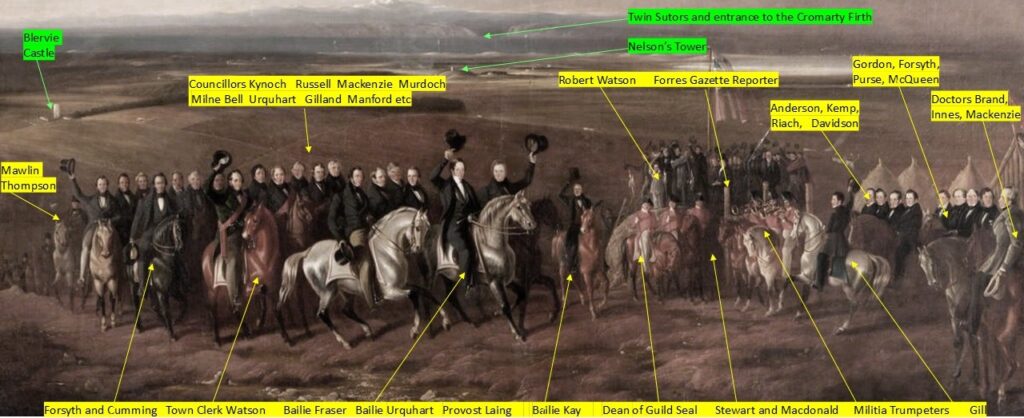
“Foremost to the people in the painting is PROVOST LAING with his hat upraised, quietly saluting the surrounding hundreds who are posted on the rock and scaffolding etc adjacent, awaiting the arrival of the procession. The Provost’s (image) is a good likeness. To his right is BAILIE FRASER, and on his right ALEXANDER URQUHART, mounted on grey chargers. Bailie Fraser appears hat in hand, to be takin the matter very coolly; but his associate in authority has his patriotism aroused to the highest pitch, and seems giving vent to his excited feelings by a hearty cheer, while he swings his hat around his head. Next we have BAILIE KAY – also a good likeness, and the DEAN OF GUILD SEAL, a decided hit, both of course uncovered. The Bailie is looking around with a calm dignified air, and the Dean’s profile cannot be mistaken by any person the least acquainted with this most useful public man. Next, we have the TOWN CLERK and MR GEORGE CUMMING, Writer to the Signet, the Town’s Edinburgh agent, all bearing the various insignia of their offices suspended by broad crimson belts. MR WATSON’s hat is gracefully raised in one hand, and his extremely exposed figure as he occupies the near side of the picture is admirably drawn and painted. The likeness is also very striking. Mr Forsyth appears in one of his happiest moods, and his courteous cheerful countenance is illuminated by a smile of complacency at the scene around him. COUNCILLOR WHITE occupies the extreme left of the line, and appear as if on tiptoe in the stirrups, making some observation to his right hand neighbour – the likeness is excellent and characteristic.
The next rank comprises COUNCILLOR KYNOCH and RUSSELL, who are both well drawn, COUNCILLOR McKENZIE’s physiognomy may also be recognised, although a little in the shade under the town clerk’s raised arm. Next in order of procession we have COUNCILLORS MURDOCH, MILNE and BELL, the whole of whom are good portraits, particularly the latter. COUNCILLOR ROBERT URQUHART, (now BAILIE ROBERT URQUHART,) on a find black pony, his favourite Flora occupies the near side of the line, comprising COUNCILLORS GILLAN and McDONALD etc: the Bailie’s likeness is also good. He is succeeded by COUNCILLOR MANFORD on a cream-coloured stead, bringing up the rear of the council.
Close behind is the striking likeness of MAWLEN THOMPSON, the town’s GROUND OFFICER, and behind him an innumerable throng of men appear climbing the hill and gradually lessening in the distance. To the right side of the picture, close in the foreground are three gentlemen belonging to the town on horseback. Next the outside are DRS BRANDS, INNES, and McKENZIE: DR BRANDS is a perfect likeness; the other two are fair portraits. In front of these are MASTER ALEXANDER GORDON, Elm Cottage, MR JAMES FORSYTH, writer, MR WILLIAM PURSE, merchant and MR McQUEEN, Belnageith. Next Messrs JOHN ANDERSON, merchant, KEMP of Rio Janeiro, RIACH, ironmonger and DAVIDSON, banker. In front of them is MR GILL, merchant, one of the marshals on the occasion.
Mr Gill reins in a restive steed as he points to the place where the procession is to stop. MR SCANDLERS, writer, another of the marshals, occupies the space between the Provost and the gentleman to the right. Near the extreme right is the farm-steading of Mr Simpson, one of the town’s tenants, and indicative of the loyalty of the occupiers to their superiors, a turkey-red handkerchief is hoisted on a pole as a flag and surmount the gable of one of the buildings! At a little distance is the Califer stone and a scaffolding close to it on which a number of individuals are seen waving hats etc, and a union jack floats over their heads. The faces of course are to distant to be recognised; but if we mistake not, our reporter is in the front rank with notes and pencil; and Master ROBERT WATSON, eldest son of the town-clerk, also occupies a very prominent place. In front of the stone the TOWN’S OFFICERS in complete uniform, are drawn up. STEWART and McDONALD are striking likenesses. Three trumpeters, in the uniform of the Inverness-shire Militia, front the procession playing their instruments.
The picture, if viewed merely as a LANDSCAPE is very valuable. The point of sight is from Califer Hill at the DOUPING STONE. On the left is Blervie castle, overlooking prolific arable lands waving with golden grain. Further to the left is the rich wooded district along the banks of the Findhorn. Still more remote, Darnaway Castle, the beautiful norther seat of the noble Earl of Moray is seen amidst dense forests. Further down is Knockomie Cottage and the village of Belnageith, Findhorn Bridge, and Dalvey Mansion House. The sinuosities of the river Findhorn are seen like silver threads until they finally burst out and meet the tide in an unbroken sheet between Kinloss and Binsness.
The view of the low country from the eminence of Califer is the most magnificent that can be conceived. It embraces an extent of 20 miles in one glorious panorama from the Califer to the Caithness Hills and from Randolph’s Hall to the town of Findhorn. The burgh of Forres is observed at some distance, embosomed as in the paradise of gardens, orchards and fertile fields, and although partly hid by the hills of Burdsyards its extent and position may be known by soft and beautifully transparent haze which rests upon the town. Nelson’s monument are, however, seen; as also are Drumduan, Grange Hall, Invernerne, Hillhead etc. On the extreme right is the Town of Findhorn, mirror’d in the crystal tide. Two steam vessels are passing up the Firth, and several ships of various burthen are here and there disposed on the bosom of the deep. Far in the distance the cloud cap’t hills of Ross and Sutherland rise in shadowy indistinctness. In the western range is Ben Wevis, with it’s summits covered in eternal snow. The cliffs of Cromarty are lighted up by a bright beautiful sky. At the east, a partial shower shades the landscape; but this is partly relieved by a judiciously placed rainbow which throws its brilliant hues over the gloom.
The Riding of the Marches is recorded in the Annals of the Royal Burgh of Forres by Robert Douglas that was published in 1934
In the Town’s Buildings there may be seen two paintings which call for more than a passing glance. In the Court Room is The Riding of the Marches on 1st October 1840 and in the Council Chambers The Tournament. The paintings are from the brush of a young London artist (Mr Cranmer) of the time, and were completed in 1841. As to the manner in which these were procured by the Town, the following is taken from the Records of that period:-
This elaborate work of art has at length become the property of the Burgh at the subscription price of fifty guineas {£52.50} without touching a farthing of the Town’s funds.
The Riding of the Marches
The painting represents the van of the cavalcade as having reached the douping stone. Foremost in the throng is Provost Laing, with his hat upraised, quietly saluting the surrounding hundreds, who are posted on the rock and scaffolding, etc., adjacent, awaiting the arrival of the procession. To his right is Bailie Fraser and on his left Bailie Alexander Urquhart, mounted on grey chargers. Bailie Fraser appears, hat in hand, to be taking the matter very calmly, but his associate in authority has his patriotism roused to the highest pitch and seems to be giving vent to his delighted feelings by a hearty cheer, while he swings his hat around his head. Next we have Bailie Kay and Dean of Guild Seal. The Bailie is looking round with a calm, dignified air, and the Dean’s profile cannot be mistaken.
After them we have the Town Clerk (Mr Watson) on a noble looking courser, Treasurer Forsyth and George Cumming, W.S., the Town’s Edinburgh agent, all bearing the various insignia of their offices suspended by broad crimson belts. Mr Watson’s hat is gracefully raised in one hand, and his entirely exposed figure, as he occupies the near side of the picture, is admirably drawn and painted. Mr Forsyth appears in one of his happiest moods, and his courteous, cheerful countenance is illuminated by the smile of complacency of the scene around him. Councillor White occupies the extreme left of the line, and appears as if on tip=toe in the stirrups, making some conversation with his right hand neighbour. The next rank comprises Councillor Kynoch and Russell. Councillor Mackenzie’s physiognomy may also be recognised, though a little in the shade under the Town Clerk’s raised arm. Next in order of procession we have Councillors Murdoch, Milne and Bell. Councillor Robert Urquhart on a fine black pony Flora occupies the near side of the line, comprising Councillors Gillan, Macdonald, etc. He is succeeded by Councillor Manford on a cream coloured stead, bringing up the rear of the Council. Close behind is a striking likeness of Mawlin Thompson, the Town’s ground officer, and behind him a considerable throng of men and horses climbing the hill.
To the right hand of the picture, close to the foreground, there are three groups of gentlemen belonging to the Town on horseback. On the outside are Dr Brands, Dr Innes and Dr Mackenzie. In front of them are Master Alex. Gordon, Elm Cottage; Mr James Forsyth, writer; Mr Wm. Purse, merchant and Mr M’Queen Balnageith; also Messrs John Anderson, merchant; Kemp of Rio de Janeiro; Riach, ironmonger; and Davidson, Banker. Immediately in front of them is Mr. Gill, merchant, one of the marshals on the occasion, reining in a restive steed, as he points to the place where the cavalcade is to stop. Mr Scandlers, writer, another of the marshals, occupies the space betwixt the Provost and the gentlemen to the right. On the stone is Mr John Miller, Forres Gazette, with notebook and pencil in hand, and Mr Robert Watson, eldest son of the Town Clerk, who also occupies a very prominent position, In front of the stone are the Town’s officers, Messrs Stewart and Macdonald in complete uniform. Three trumpeters in the uniform of the Inverness-shire Militia are in front of the process ion blowing their instruments. From reports it is state that the likenesses are very characteristic and striking.