
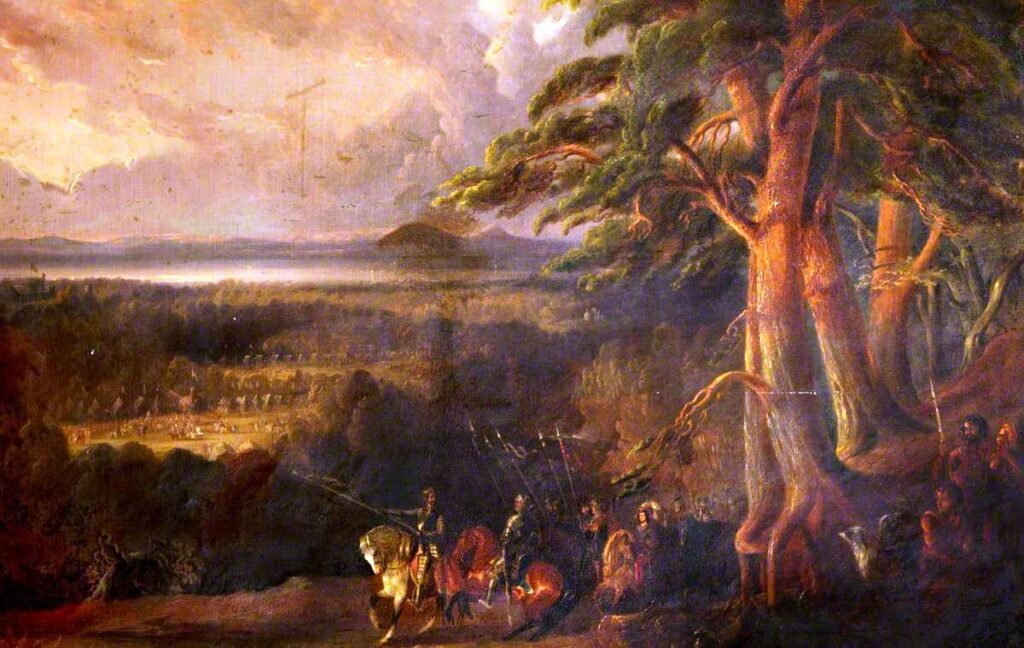
This painting was also recorded in the Annals of the Royal Burgh of Forres by Robert Douglas that was published in 1934
In the Town’s Buildings there may be seen two paintings which call for more than a passing glance. In the Court Room is The Riding of the Marches on 1st October 1840 and in the Council Chambers The Tournament. The paintings are from the brush of a young London artist (Mr Cranmer) of the time, and were completed in 1841.
In the case of The Tournament, it was the painter’s intention, if it was not speedily disposed of, to send it to the Royal Academy, London, for sale, but, as the subject was local, the feeling was expressed that it be not allowed to leave Morayland. The picture was disposed of by lottery, and Provost Robert Urquhart reported to the Council on 16th November 1841, that the prize had fallen to the Hon. The Earl of Fife, and that his lordship, in the most handsome manner, made a present of it to the Town of Forres. He congratulated the Council and the community on receiving so valuable a testimony of his lordship’s friendship, and he moved the thanks of the Council to be voted to his lordship, which was seconded by Bailie Gill, and carried with acclamation.
The Tournament
The subject of this painting was taken from Sir Thomas Dick Lauder’s Wolfe of Badenoch, which informs us that in the reign of Robert II., the Earl of Moray, son-in-law of that Monarch, invited the Scottish nobility to his castle of Darnaway, in the vicinity of which he purposed holding a tourney – one of these stirring fetes in the days of chivalry. The subject is highly interesting, and the artist has done it ample justice. Apart altogether from its being a representation of The Tournament, the merit of the picture, as a landscape is immense. The rich and magnificent scenery on the bank of the Findhorn is highly characteristic, and is exquisitely painted. On the left is the ancient Castle of Darnaway, majestically over-topping the surrounding forest; on the right the Chapel of St Johnon the elevated site near Cothall. Far in the distance are the hills of Ross and Sutherland, beautifully softened and subdued, gilded by the slanting rays of the descending sun, lighting up the Moray Firth, the mansion house of Culbin and its fertile lands, ere the desolating sands had come over them, near the foreground, on the opposite side of the river, are the Meads of St John, covered with the gaily coloured tents of the gallant knights, who, mounted on richly caparisoned horses, occupy the field in all directions.
On the left bank of the river, is a procession on its way to join the revels, foremost in which is Loar Alexander Stewart, the Wolfe of Badenoch, and his four sons, accompanied by Sir Patrick Hepburn of Hailes, and English Knight; the Lady de Vere disguised as a page, under the feigned name of Maurice de Grey, and a host of retainers and men at arms. The Wolfe and his attendants are mounted, in complete steel armour, on noble steeds, each knight carrying a lance with pennon attached. Sir Patrick appears as if engaged in conversation with The Wolfe. The latter, pointing with his spear to the glittering pageant on the Meads and reining in his charger, seems as if repeating the words attributed to him by the historian,
The Earl of Moray must have his hands in the King’s breeches pocket, or he could not have exhibited a scene like that.
The rear of the procession is hid by two ancestral trees, under the shade of which three savage-looking ghillies, unshaven, unkempt and almost naked, appear as if startled by the passing cavalcade; two of them grasping their spears and anxiously surveying the throng, while the third is employed dressing venison, Beside them are a pair of beautiful deer hounds, finely grouped, painted from some in the possession of His Grace the Duke of Richmond. The painting of The Tournament was repaired and cleaned in 1930.